
How to Search Swift County Court Records
Start with Minnesota Court Records Online, which the Minnesota Judicial Branch uses as the public gateway to many district court records. MCRO is the main place to search Swift County court records because it includes Case Search, Document Search, Hearing Search, and Judgment Search. Case Search works best for names, case numbers, citations, and attorney lookups. Document Search is the follow-up tool when the case number is known and the document is public. Hearing Search is useful for scheduled hearings, and Judgment Search is the route for debtor-name money-judgment information.
Before starting, decide whether the goal is to find the case, read the docket, inspect a public document, or get a certified copy. That choice matters because MCRO is an unofficial access layer, not the certified court record. Swift County Court Administration is still the office that handles official copies, courthouse-only materials, and questions about records that do not display online. If the search is about a traffic citation or a criminal case, the citation number or case number often narrows the result faster than a broad name search.
The basic search path is simple:
- Open MCRO and choose the search tab that matches the information you already have.
- Select Swift County in the county filter when the search allows county selection.
- Enter a person, business, attorney, citation, or case number.
- Open the case detail page to read the register of actions and any public documents.
- Use Court Administration for certified copies, restricted files, or anything not shown online.
The MCRO overview page at Minnesota Court Records Online shows the four public search paths and the branch's reminder that remote access is limited by court rules. That is the right first screen for a Swift County case lookup, but it does not replace the local court file.
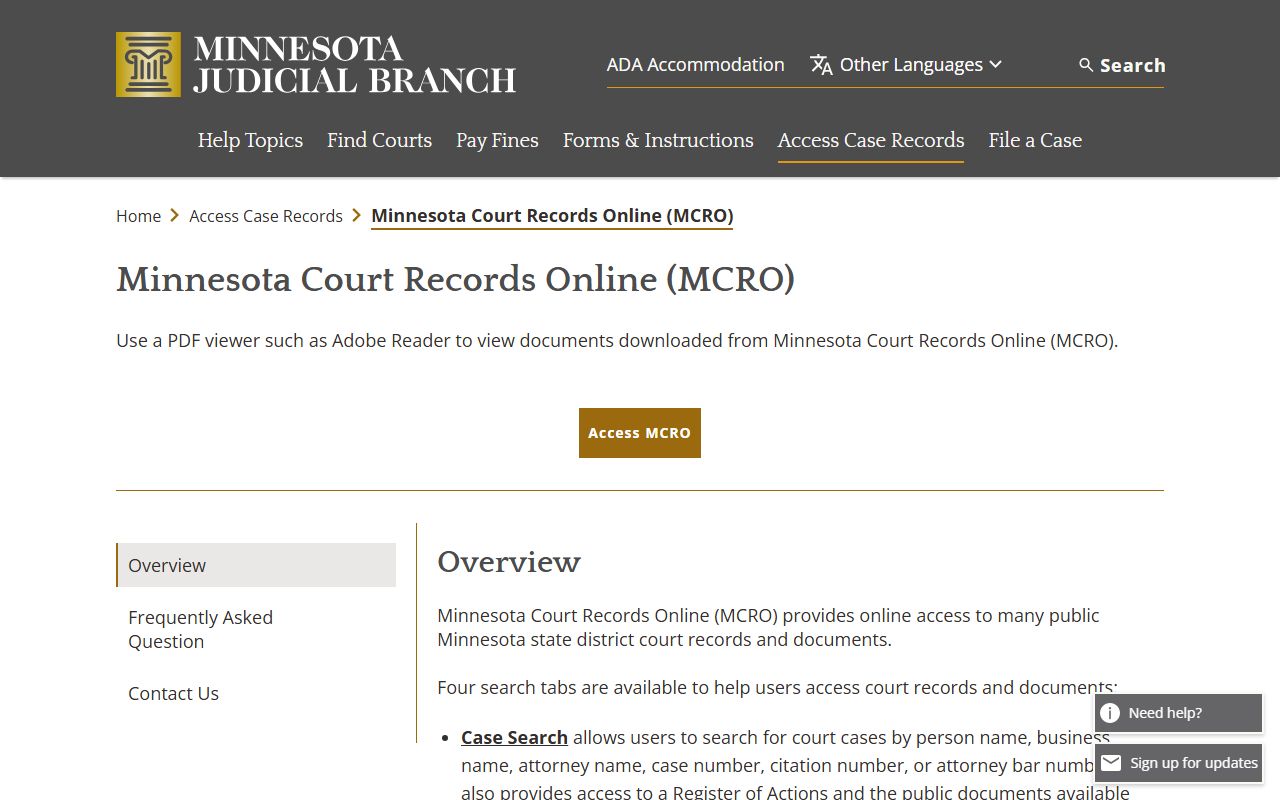
The overview image is useful because it shows the portal family before a search begins, which helps separate the public online view from the official local case file.
The MCRO Case Search page is the most common starting point when a user has a name, a case number, or a citation number. Swift County users usually search that tab before asking the clerk for copies, because the result list can show whether the case is active, inactive, civil, criminal, family, probate, or another public district court matter.
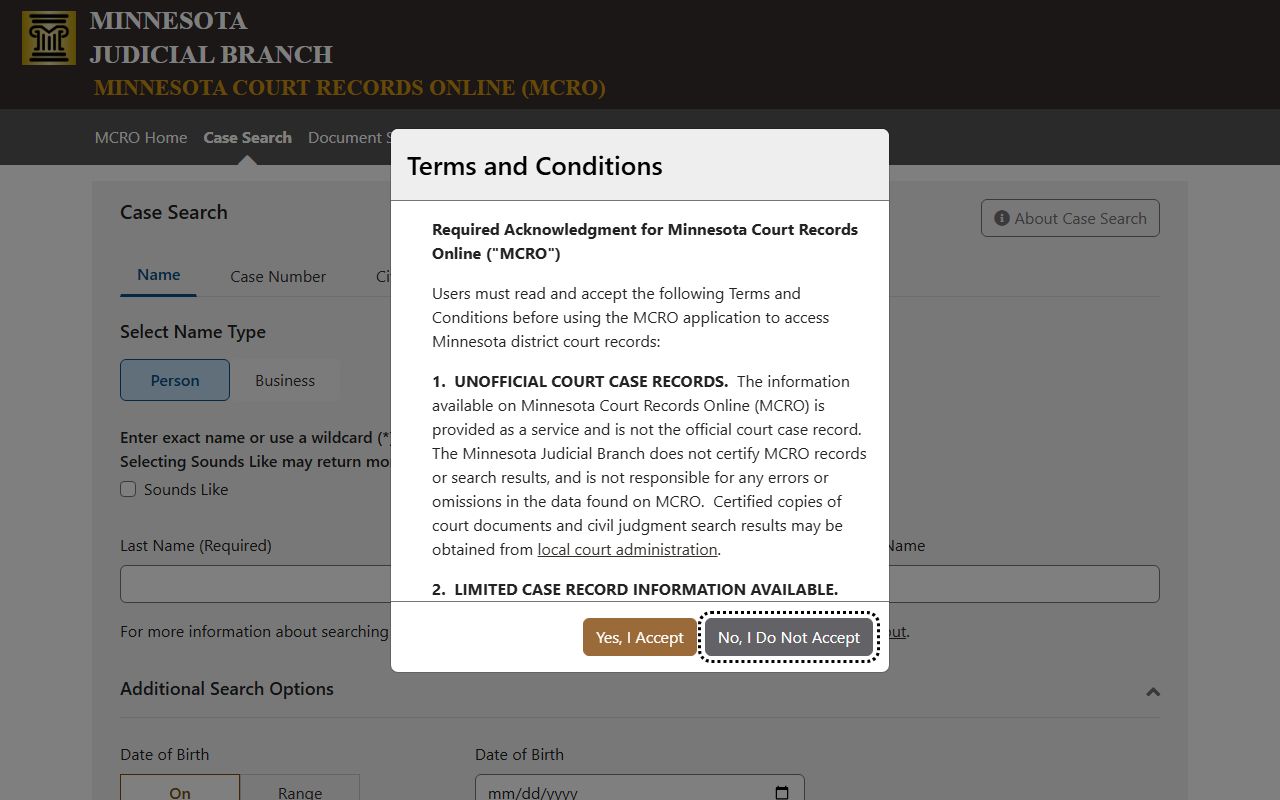
That search screen is the quickest online route for case lookup, especially when the record is tied to a name, a citation, or a case number rather than to a document title.
Swift County Court Records Search Fields
MCRO does not use a single universal form for every record type. The Case Search and Hearing Search tabs expose different filters, and both are more useful when the user understands what each field does. A Swift County court records search usually starts with the name tab, but the case number and citation number tabs are often better when the goal is a known traffic citation, a criminal filing, or a docket already pulled from a notice or calendar.
| Field Label | Type | Required | Notes / Format |
|---|---|---|---|
| Name tab | Tabs | Yes | Person, business, or attorney search paths. |
| Last name | Text | Yes for name search | Exact or wildcard after at least two characters. |
| First name | Text | No | Used for person-name searches. |
| Case number | Text | Yes for case-number search | Best for direct case lookup and document search. |
| Citation number | Text | Yes for citation search | Useful for traffic and criminal citation lookups. |
| Attorney name / Minnesota license number | Text | Conditional | Attorney tab supports both formats. |
| Case category | Filter | No | Civil, criminal, family, probate or mental health. |
| Case status | Filter | No | All, Active, or Inactive. |
| County location | Filter | No | Select Swift County when narrowing statewide results. |
| Sounds Like | Checkbox | No | Broadens results, but wildcards do not work with it. |
The public hearing calendar uses a different set of fields, but the same logic applies. Case number format matters in Swift County because the sample calendar uses county code 76 and category codes such as CR, CO, and PR. That is why a search result can be easier to verify when the number matches the calendar or the case notice exactly.
Types of Swift County Court Records
Swift County District Court handles the county's civil, family, probate, juvenile, criminal, and traffic cases. That means the local court record file can contain everything from a small-claims style conciliation matter to a criminal complaint, a probate petition, or a traffic citation. Court records are not one uniform thing. A docket entry, a judgment search result, a public hearing notice, and a certified copy each answer different questions, and the right search depends on what the user wants to know.
The local court office is Court Administration at the Swift County Courthouse, but not every related record lives there. Marriage records route through the Auditor-Treasurer and the Minnesota Official Marriage System, while land titles and related recordings route through Land Records. Federal cases, bankruptcy cases, and BCA criminal-history checks are separate records systems. For a Swift County court records page, the main focus stays on the district court file, the online public layer through MCRO, and the local office that certifies or completes records requests.
- Civil records track lawsuits, judgments, satisfactions, and other money or relief disputes.
- Criminal records track complaints, pleas, hearings, sentencing, and disposition.
- Family and probate records track dissolution, custody, estates, guardianships, and related petitions.
- Traffic records track citations, appearances, payment, and court outcomes.
The same county court file can also produce more than one view. A hearing entry may show up first on the calendar, then in the register of actions, and later in a public document or certified copy. That is why court records work best when the searcher understands both the filing type and the stage of the case.
What Swift County Court Records Show
A Swift County court file normally shows the core identity of the case, the court handling it, the parties, the case category, the filing date, and the chronological actions that followed. Public documents can add more detail, but even a basic Register of Actions usually gives enough context to tell whether the matter is active, closed, appealed, or waiting on a later hearing. The online file is helpful, yet the local office still matters when a record needs certification or when the online display omits a restricted piece of information.
| Field | What It Shows |
|---|---|
| Case Number | Swift County format such as 76-CR, 76-CO, or 76-PR followed by year and sequence. |
| Filing Date | The date the district court file opened or the action was entered. |
| Parties | Plaintiff, defendant, petitioner, respondent, decedent, creditor, or debtor depending on case type. |
| Hearing History | Dates, times, judicial officers, hearing types, and related case events. |
| Register of Actions | The docket-style list of filings, orders, hearings, judgments, and satisfactions. |
| Disposition | The result or current status, such as dismissed, active, inactive, or satisfied. |
The MCRO Document Search screen is the next step when the case number is known and the user wants a public document rather than a simple case summary. Document Search is especially helpful for motions, notices, and orders that are public online, but it still will not replace a certified copy from Court Administration when an official copy is required.
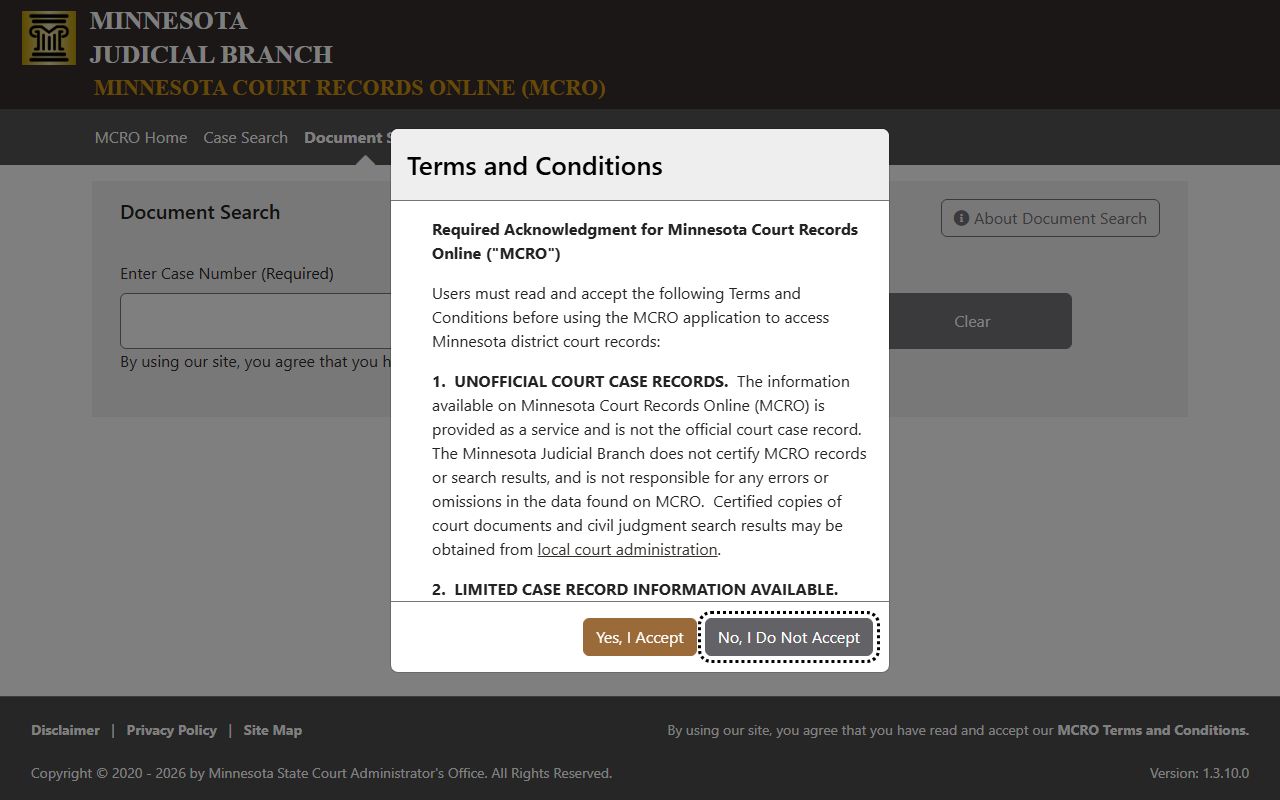
That document screen matters because it shows the difference between a docket view and a document view. Users looking for the actual paper or PDF version of a filing usually need the case number before Document Search works well.
The MCRO Judgment Search tab is narrower, but it matters when the court record includes a docketed money judgment. The portal is debtor-name based, so it is not the same as a general case lookup. It is one more reason to separate the case file from the other online views that live inside MCRO.
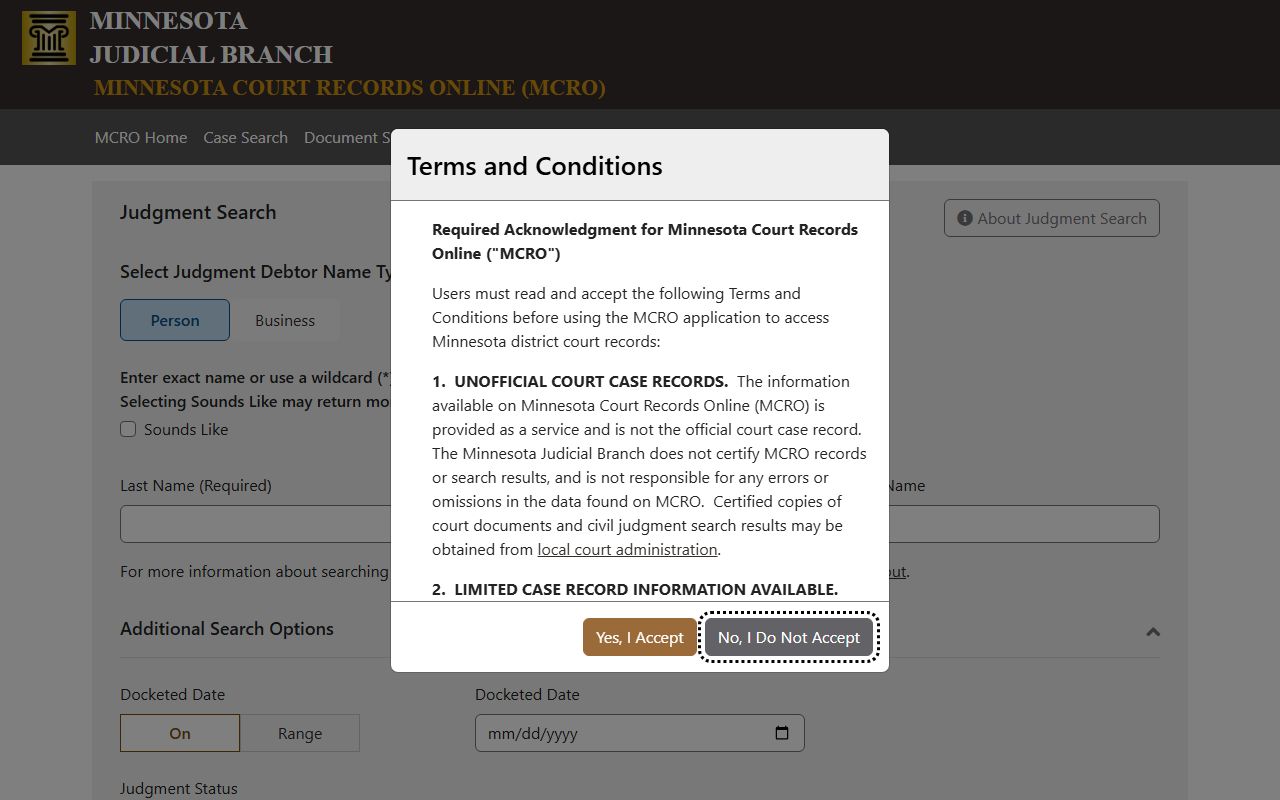
Judgment Search is the right tool for money-judgment details, not for every case file. Swift County users should treat it as a specialized view inside the larger court-records system.
Public Access Framework for Swift County Court Records
Minnesota law presumes government data are public unless another law classifies them differently, and the judicial branch also limits what can be shown remotely online. For court records, that means Swift County users can often read public information online, but they still need the local court office for certified copies and for files that are restricted, sealed, or only available at courthouse terminals. The key rule is simple: online access is useful, but it is not the same as the official record.
Two sources control the public-access framework most directly: Minn. Stat. section 13.03, which states the presumption that government data are public unless classified otherwise, and the Minnesota Rules of Public Access to Records of the Judicial Branch, Rule 8, which limits remote online display. Swift County searchers should expect public online results, but also expect redactions, withheld fields, and records that are only available in person. Court Administration can explain copy procedures, certification rules, and whether a record needs to be picked up at the counter.
The public-access page at Minnesota Court Records Online also warns that the branch does not certify MCRO records or search results. That matters whenever a person needs a court filing for a licensing office, a landlord, a lawyer, or any other situation that requires an official copy.
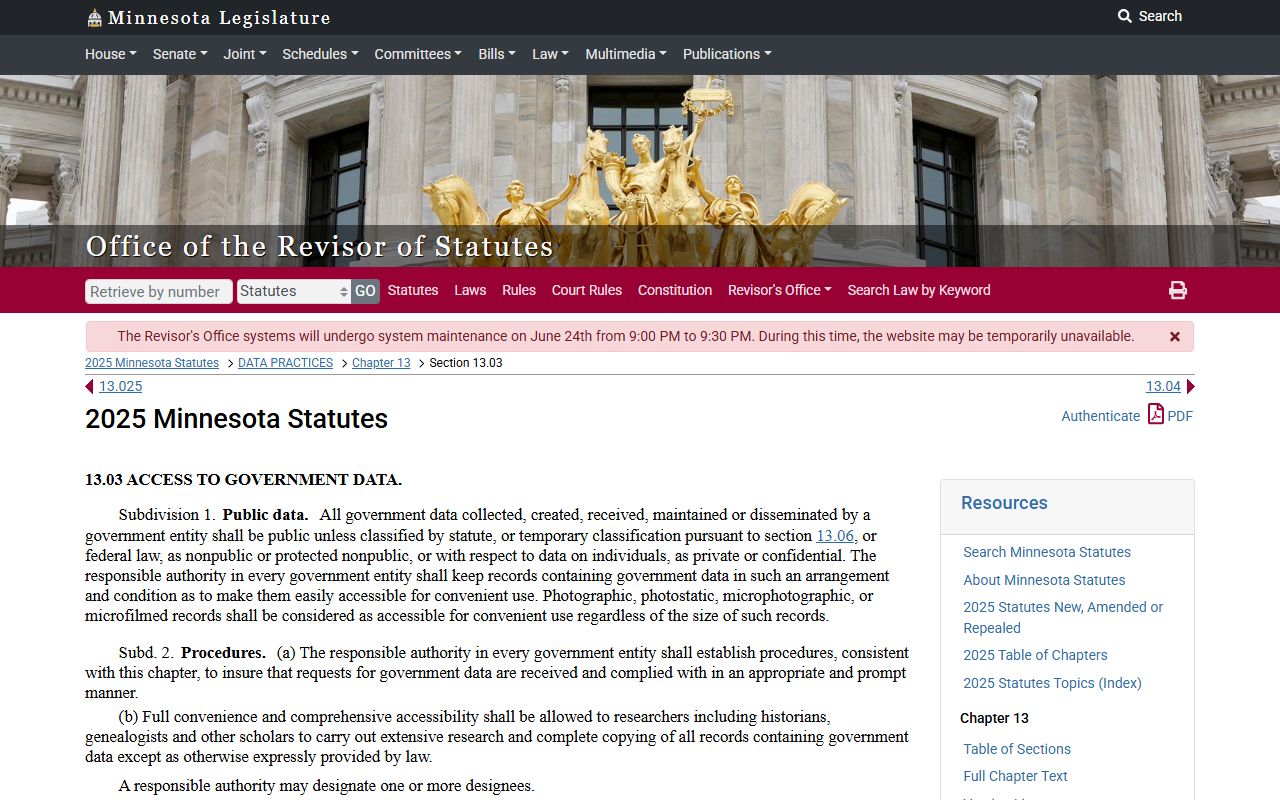
The public-access image reinforces the central rule for county court records. Public does not mean unlimited, and remote access does not mean certified access.
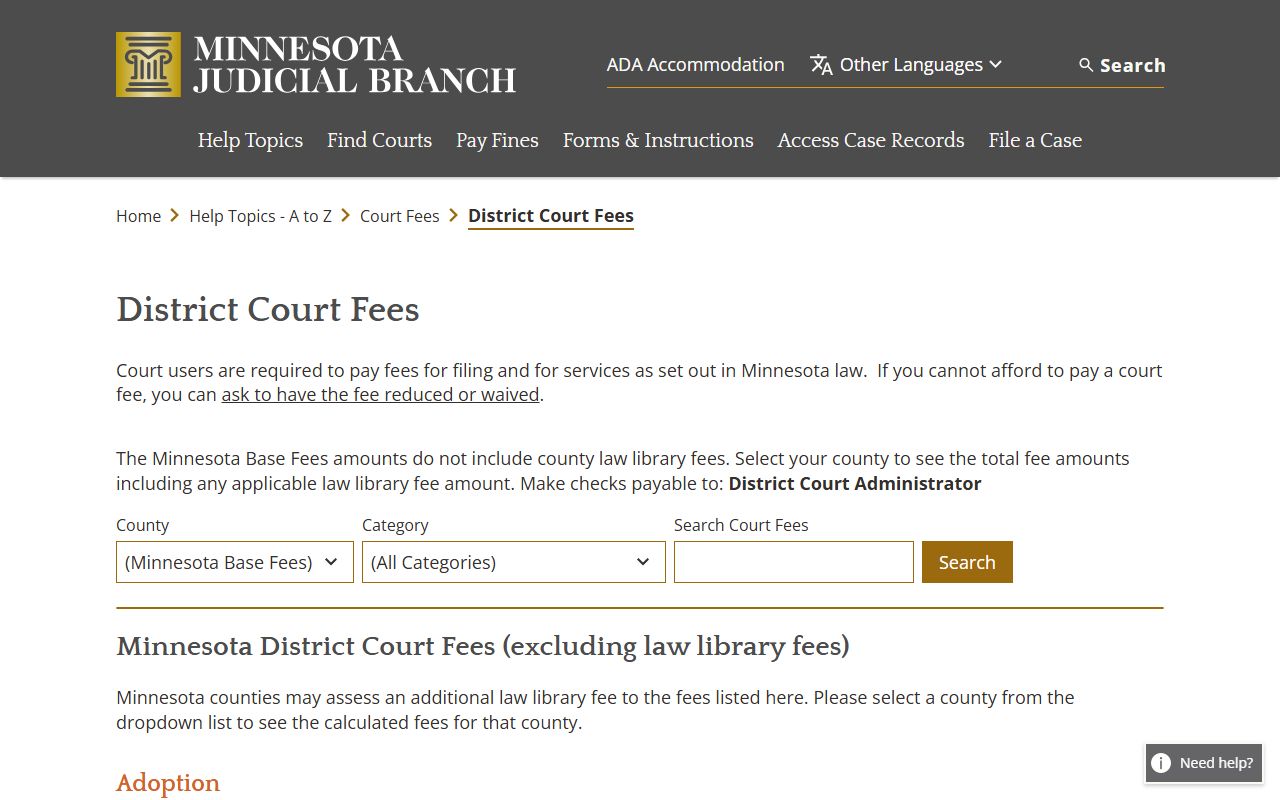
The fee schedule screen is useful because it reminds searchers that copies, filings, and other court services have set charges. Those fees belong to the court system, not to the online search portal itself.
Case Numbers and Fees
Swift County uses Minnesota district court case-number formats, and the public calendar gives the clearest example of how those numbers look in practice. The county code is 76, followed by the case category and a year-sequence identifier. That format is useful because it lets users match a calendar entry, a filing notice, and a case lookup result without guessing which county or case type they are looking at. When a case number is known, it also helps the user choose the right MCRO search tab or the right document lookup path.
| Item | Amount | What It Covers |
|---|---|---|
| Certified copy of an instrument | $14 | Certified copy from a civil or criminal proceeding. |
| Certified printout / screen print | $14 | Certified output from the case-management view. |
| Faxes | $25 per 50 pages | Court fax processing. |
| Civil first paper filed | $310 | General civil first filing fee. |
| Criminal expungement filing | $310 | Filing fee for a criminal expungement petition. |
| Probate first paper filed | $310 | Probate opening fee. |
Those are the kinds of fees that matter when a search turns into a records request. An online result may be free to read, but a certified copy, a fax, or an initial filing is a different service. For Swift County users, that distinction is often the difference between a quick public lookup and a formal courthouse request.
Records That Are Sealed or Confidential in Swift County
Some Swift County records are not open in the same way as an ordinary civil or criminal case file. Juvenile records, domestic abuse orders for protection, harassment restraining orders, civil commitment public-document sets, sealed criminal files, and records that are confidential by statute or court rule can all be withheld or heavily redacted. MCRO also excludes some restricted case types from remote display. The result is that a search can be accurate and still incomplete, because the branch is following access rules rather than omitting a case by mistake.
Expungement is sealing, not deletion. If a record is eligible for relief, the person must use the process in Minn. Stat. section 609A.03, and the practical effect is to remove the record from public view while leaving the underlying file subject to legal access rules. Juvenile access is also controlled by Minn. Stat. section 260B.171. A person seeking access to a sealed or restricted record should expect to show a legal basis, not just curiosity, and Court Administration can explain whether a court order or petition is required.
Restricted records often show up only as partial references, so the absence of a document in the public portal does not necessarily mean the underlying case does not exist.
In-Person Court Record Requests
When the online portals stop short, Swift County Court Administration is the place to ask about certified copies, older files, courthouse-terminal access, and any record that is not public online. The office is open during the county's regular courthouse hours, but the lunch closure matters because counter service is not continuous through the day. A searcher who needs an official copy should bring identifying information, the case number if known, and a clear explanation of what record is needed.
Court Administration
Swift County Courthouse, 301 14th Street N.
Benson, MN 56215
(320) 843-2744
Monday-Friday, 8:00 a.m.-4:30 p.m., closed 12:00 p.m.-1:00 p.m.
For users who need a document that can be certified, the local counter is the final step. The public portal can point the way, but Court Administration is where the official copy comes from.